
How to Ventilate and Heat in Winter to Prevent Mould
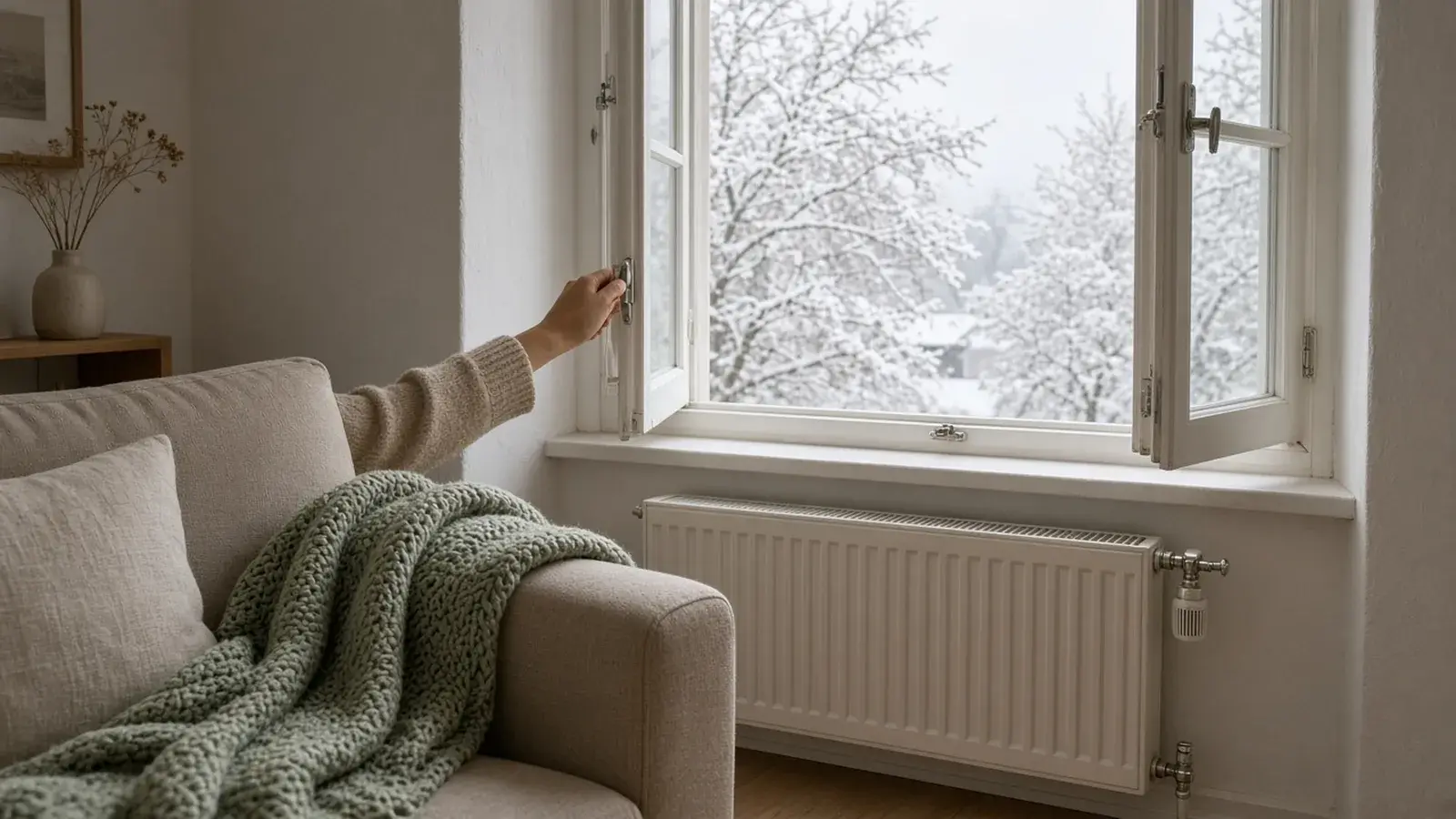
In winter, air rooms fully 3–4 times a day: open windows wide, ideally on opposite sides for a cross-draught, for about 5 minutes depending on the outside temperature. Turn the radiator thermostat down while airing and back up afterwards. Don't leave windows tilted for hours; it chills the walls and wastes heat. Don't let rooms drop much below 16 °C, and keep doors to cooler rooms closed.
Why homes get damp in winter
A household of two or three releases several litres of water into the air every day through breathing, showering, cooking and drying laundry. Warm air can hold this moisture. When it hits a cold surface such as glass, an external wall or a room corner, it cools and releases the water again. The result is condensation on windows or hidden damp in the wall, and that’s where mould grows.
The solution has two parts that belong together: get moist air out regularly (airing) and keep surfaces warm enough (heating).
How to air properly
Full airing: open windows wide, don’t tilt them. Stale, moist air is quickly swapped for cold, dry outdoor air. Walls and furniture stay warm and reheat the fresh air quickly.
Cross-ventilation: even better, open windows on opposite sides at the same time. With a draught, the air exchange is often done within a few minutes.
How often? In winter 3–4 times a day, plus after showering, cooking and when laundry is drying.
| Outside temperature | Airing time (without cross-draught) |
|---|---|
| below 0 °C | about 5 minutes |
| 0–10 °C | about 5–10 minutes |
| above 10 °C | 10–15 minutes or longer |
A hygrometer helps: if humidity is back around 40–50 % after airing, you aired long enough.
How to heat properly
- Heat all rooms moderately. A bedroom at 14 °C is a classic mould candidate because the walls are so cold.
- Steady rather than a rollercoaster. Switching off completely and blasting it in the evening saves less than you’d think and lets walls cool down. A night setback of a few degrees is enough.
- Close doors between rooms at different temperatures.
- Keep radiators clear of long curtains, sofas and laundry.
- Bleed radiators if they gurgle or stay cold at the top.
A simple daily routine
- After getting up: air the bedroom for 5 minutes, squeegee condensation off the glass.
- After showering: air the bathroom and wipe tiles and screen, see Remove mould in the shower.
- Midday or when you get home: air the whole flat once.
- After cooking: air the kitchen and leave the extractor running for a few minutes.
- Before bed: a short burst of airing once more.
If you’re out during the day, air thoroughly morning and evening. A smart thermostat with a schedule can warm the flat shortly before you get back.
And if the air gets too dry?
In hard frost the outdoor air is very dry. If you air a lot, humidity can drop below 35 %. Then air a bit more briefly and see Dry air from heating. The target is always roughly 40–60 %.
Products that actually help
Digital thermo-hygrometer
Shows temperature and humidity at a glance, so you can see when to air and whether it worked.
Link coming soon (TODO: Amazon UK/US Associates ID)Smart radiator thermostat
Schedules and open-window detection lower the temperature at night and while airing automatically.
Link coming soon (TODO: Amazon UK/US Associates ID)Window squeegee
Clears morning condensation from the glass in seconds, before it runs into the frame.
Link coming soon (TODO: Amazon UK/US Associates ID)Stop it happening again
- Air the bedroom right after getting up; that's where a lot of moisture builds up overnight.
- Air after showering and cooking, with the bathroom door closed.
- Turn the thermostat to frost protection (✱) while airing, then back.
- Don't block radiators with furniture, curtains or laundry, or the heat won't reach the room.
- Lower the temperature moderately at night and when you're out, but don't switch off completely.
FAQ
How long should I air rooms in winter?
In frost, 5 minutes of full airing is usually enough; in milder weather (around 5–10 °C) more like 10 minutes. A cross-draught through opposite windows speeds it up. Rule of thumb: until the air is fresh, but before walls and furniture cool down.
Isn't a tilted window better than no airing at all?
A permanently tilted window exchanges little air but strongly chills the lintel and reveals. That's exactly where condensation and mould appear, and a lot of heat is wasted. Short, full airing is much better.
What temperature for which room?
Common guidelines: living room about 20 °C, kitchen about 18 °C, bedroom 16–18 °C, bathroom about 22 °C. More important than the exact figure is that no room gets very cold for long periods.
Can I warm the cold bedroom with warm air from the living room?
Better not. Warm air carries a lot of moisture, which then condenses on the cold bedroom walls. Keep doors to cooler rooms closed and heat each room with its own radiator.
What do the numbers on the thermostat mean?
On many standard thermostatic valves, setting 3 is roughly 20 °C and each step is about 3–4 °C. The thermostat sets the room temperature, not the heating speed: 5 doesn't heat faster, it just keeps going until it's very warm.
How much does one degree less save?
A common rule of thumb is about 6 % heating energy per degree. But only as long as it doesn't get so cold that damp and mould problems start.
Related problems
Dehumidifier or Hygrometer: What Actually Helps Against a Damp Home?
Damp walls, wet windows, musty smell? How to measure humidity properly and tell when you really need a dehumidifier.
Cold Feet, Cold Home: Stay Warm and Save on Heating
Heated throw, hot water bottle, draught excluder & co.: how to get warm at home without turning the heating right up. With safety tips.
Use a Fan Heater Safely: Avoid Fire Risks and Work Out Real Running Costs
Fan heaters warm up fast, but they use a lot of power and are a common cause of fires. How to use them safely and calculate the cost yourself.