
Condensation on Windows: Causes and What Actually Helps
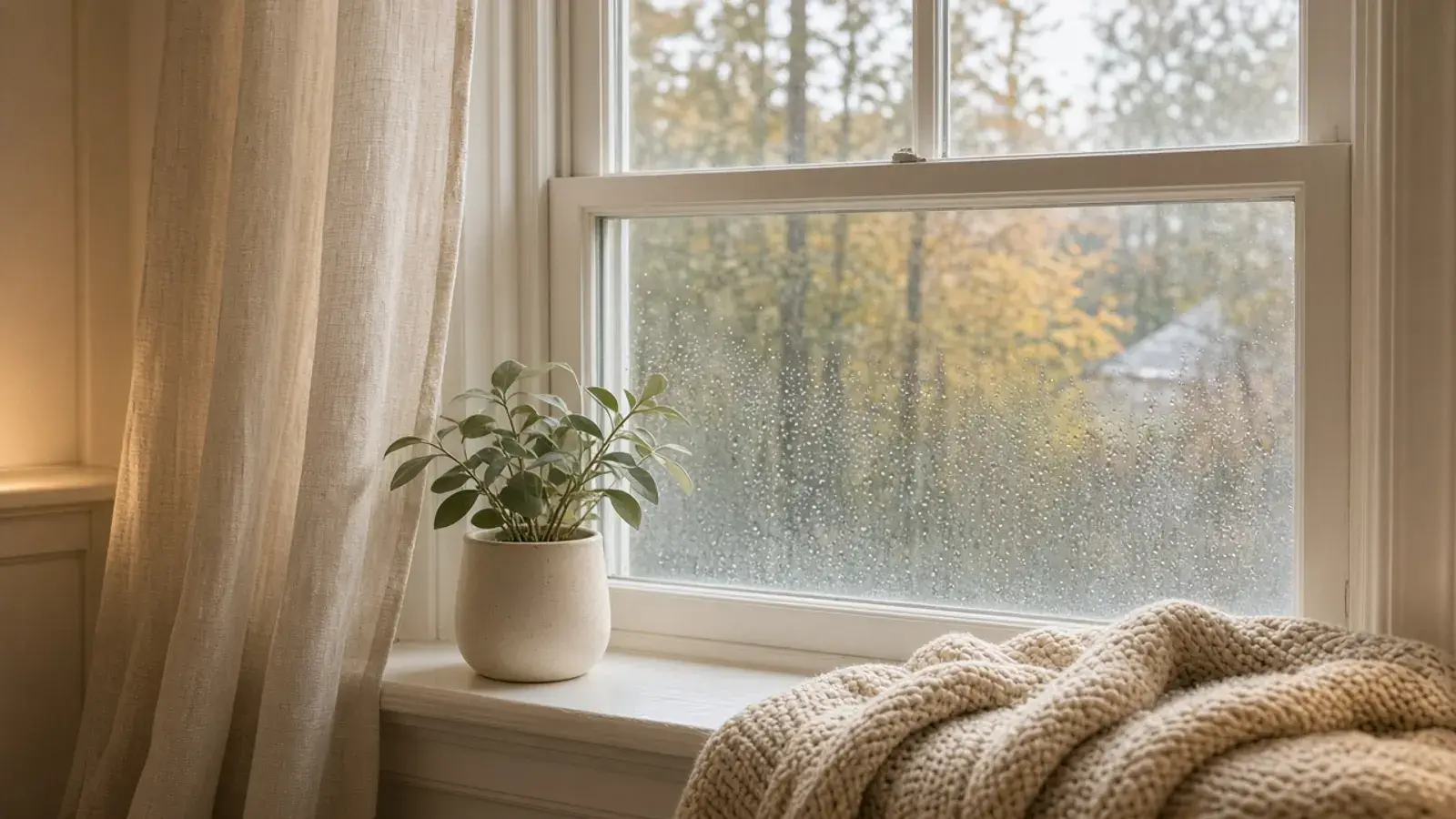
Condensation forms when warm, moist indoor air cools on cold glass. The fix: wipe the water away every morning, air rooms fully 3–4 times a day for 5–10 minutes, don't let rooms drop much below 16–18 °C, and keep humidity at 40–60 % (check with a hygrometer). If that isn't enough, a dehumidifier helps.
Why water collects on the glass
The warmer air is, the more water vapour it can hold. When warm, moist indoor air meets a cold surface it cools below its dew point, and the water condenses into droplets. In winter the window is often the coldest surface in the room, so that’s where the problem shows first.
For example, at 20 °C and 60 % humidity the dew point is about 12 °C, so any glass colder than that mists up. At 50 % humidity the dew point drops to about 9 °C. A few percent less moisture makes a big difference.
Where does all that moisture come from? A family of four releases roughly 6–12 litres of water a day into the air by breathing, showering, cooking, drying laundry and watering plants. Without enough ventilation it stays indoors and ends up on your windows overnight.
Find the cause
- Bedroom only, in the morning: you breathe out a lot of moisture overnight in a cool room. Ventilate as soon as you get up and keep the door to warmer rooms closed.
- Bathroom and kitchen: showering and cooking are the cause, so ventilate straight afterwards.
- Throughout the home: humidity is too high in general. Get a hygrometer, change your airing habits and consider a dehumidifier.
- One old window only: old double or single glazing has a cold inner pane. Better glazing fixes it for good. Until then, ventilate consistently and wipe the glass.
- Between the panes: the seal has failed and the unit needs replacing.
Quick fix: your morning routine
- Remove the water with a squeegee and an absorbent cloth, or faster with a window vacuum, before it soaks into frames and seals.
- Dry the sill and seals, especially the bottom corners.
- Air the room for 5–10 minutes with the window wide open, and turn the radiator down while you do.
- Heat the room again. A cold room forms new condensation faster.
How to ventilate properly
Tilted windows do very little. They exchange hardly any air but chill the reveal and wall, which is exactly where mould appears. Open windows fully several times a day instead.
The colder it is outside, the shorter you need. Cold winter air holds very little water. Once it warms up indoors it absorbs a lot of moisture, so 5 minutes is often enough in winter.
Time it well: after getting up, after showers, after cooking and before bed.
Heat evenly. Don’t let rooms, even unused ones, drop much below 16 °C. Cold walls attract condensation.
When a dehumidifier makes sense
A compressor dehumidifier removes roughly 10–20 litres a day depending on the model. It’s worth it if you dry laundry indoors, live in a ground-floor or basement flat, are recovering from a leak, or humidity stays above 60 % despite good airing. Use it with the doors closed and check your hygrometer to confirm the readings fall. You still need fresh air.
Renting?
Airing and heating are the tenant’s job. Faulty windows, failed glazing and cold bridges are the landlord’s. If mould appears despite good ventilation, log your hygrometer readings with dates and photos and report it in writing.
Read next
Products that actually help
Digital thermo-hygrometer (2-pack)
The most important tool. It shows when to ventilate and whether it worked. Put one in the bedroom and one in the bathroom or kitchen.
Link coming soon (TODO: Amazon UK/US Associates ID)Cordless window vacuum
Clears morning condensation from all windows in a minute, with no drips on the sill.
Link coming soon (TODO: Amazon UK/US Associates ID)Compressor dehumidifier (around 12–16 litres/day)
For homes where humidity stays above 60 % despite airing, for example when you dry laundry indoors or live in a ground-floor flat. It doesn't replace ventilation.
Link coming soon (TODO: Amazon UK/US Associates ID)Stop it happening again
- Open windows wide instead of leaving them tilted. In winter 5 minutes is often enough, in spring and autumn 10–15. Opening windows on opposite sides works best.
- Ventilate right after getting up, after showering and after cooking, when moisture peaks.
- Keep doors to cooler rooms closed, rather than letting warm, moist air drift into the bedroom.
- Don't let curtains or blinds trap the window overnight. Leave a gap so warm air can reach the glass, and keep furniture a little away from external walls.
- Dry laundry outside or in a tumble dryer where possible, or ventilate the room well afterwards.
- Plants and aquariums add moisture, so don't crowd them all onto the windowsill in winter.
FAQ
Is condensation on windows normal?
A little on cold mornings, especially along the bottom edge, is normal. Large amounts every day mean humidity is too high or the window is poorly insulated. Act before mould sets in.
Why do my new windows mist up on the outside?
That's a good sign. Modern triple glazing lets so little heat through that the outer pane gets very cold overnight, so dew forms outside on damp mornings. It clears by itself.
What is the right indoor humidity?
40–60 % is ideal for living spaces. In winter, with cold external walls, aim for the lower end (around 40–50 %). Levels constantly above 60–65 % encourage mould.
Do moisture-absorber tubs work?
Only a little. They capture a few hundred millilitres a week, while a household produces several litres of moisture a day. They're fine for a wardrobe or small room, not for a whole home.
Related problems
Dehumidifier or Hygrometer: What Actually Helps Against a Damp Home?
Damp walls, wet windows, musty smell? How to measure humidity properly and tell when you really need a dehumidifier.
How to Ventilate and Heat in Winter to Prevent Mould
Short bursts of airing instead of tilted windows, the right temperature for each room and a simple daily routine to keep your home dry and warm.
Cold Feet, Cold Home: Stay Warm and Save on Heating
Heated throw, hot water bottle, draught excluder & co.: how to get warm at home without turning the heating right up. With safety tips.