
Dehumidifier or Hygrometer: What Actually Helps Against a Damp Home?
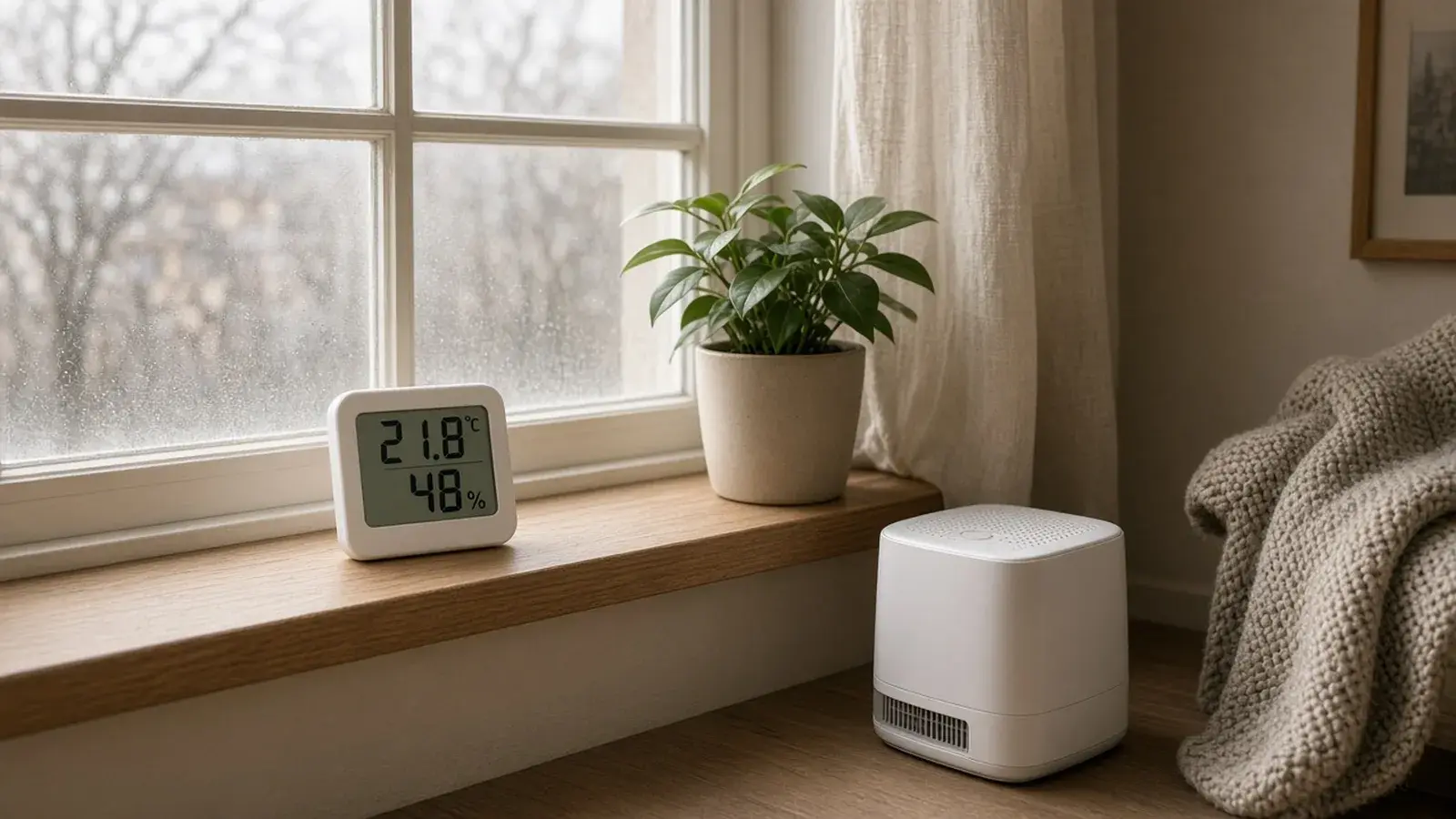
Always start with a hygrometer: it's cheap and shows whether your home is actually too damp. Aim for 40–60 %, and in winter rather 40–50 %. If humidity stays above 60 % despite airing 3–4 times a day and heating properly, an electric dehumidifier is worth it. Moisture-absorber tubs are far too small for a whole home.
Measure first, then buy
Many people buy a dehumidifier the moment their windows run wet. Often that isn’t necessary: wet windows in the morning can simply mean a lot of moisture builds up overnight and the room is aired too late. A hygrometer shows you what’s really going on.
How to measure usefully:
- Compare several rooms: bedroom, bathroom and living room behave very differently.
- Read at fixed times: after getting up, after showering, in the evening.
- Note it for a few days: only then can you see whether readings are briefly or permanently high.
How to read the numbers
| Humidity | Meaning | What to do |
|---|---|---|
| below 35 % | rather dry | air for shorter periods, see Dry air from heating |
| 40–60 % | good | carry on |
| 60–65 % briefly | normal after showering or cooking | air the room straight away |
| above 60 % for long periods | too damp, mould risk | adjust airing and heating, then dehumidifier |
Short peaks are normal. If the bathroom jumps to 80 % after a shower and is back to 55 % half an hour later, all is well. It becomes a problem when readings stay high for hours or days.
Step 1: Get airing and heating right
Before you spend money on a machine, try this consistently for a week:
- Air rooms fully 3–4 times a day, windows wide open, about 5 minutes in winter. More in How to ventilate and heat in winter.
- Heat all rooms moderately, and don’t let the bedroom drop much below 16 °C.
- Reduce moisture sources: lids on pans, extractor fan on, no laundry drying in the bedroom.
- Wipe condensation away each morning, see Condensation on windows.
If readings settle around 50 %, you don’t need a dehumidifier.
Step 2: When a dehumidifier makes sense
An electric dehumidifier is worthwhile if:
- you regularly dry laundry indoors,
- you live on the ground floor or in a basement flat, or next to cold external walls,
- after a leak, or in a new build whose walls are still drying out,
- humidity stays above 60 % despite good airing.
Compressor or desiccant? For normally heated rooms a compressor unit is the usual choice. In cold spaces like an unheated cellar, desiccant units work better.
Choose the right size: The litres-per-day figure is usually measured at 30 °C and 80 % humidity, i.e. lab conditions. In a home at 20 °C a unit removes much less. Better one size too big than too small.
Placement: in the middle of the room, away from walls and curtains, with doors and windows closed. Set the humidistat to about 50–55 %.
What about moisture-absorber tubs?
Tubs with calcium chloride or granules hold only a few hundred millilitres of water a week, depending on size. A household releases several litres of moisture into the air every day. They’re fine for a wardrobe, a camper or a guest bathroom, but they won’t noticeably dry out a damp home.
Already found mould?
You can remove small patches on smooth surfaces yourself, for example in the shower, see Remove mould in the shower. But fix the cause, or it will come back. For large areas, mould in wallpaper or plaster, or recurring growth, get a professional to find the cause.
Products that actually help
Digital thermo-hygrometer (2-pack)
The cheapest and most important step: one for the bedroom, one for the bathroom. You'll see straight away whether airing works.
Link coming soon (TODO: Amazon UK/US Associates ID)Compact compressor dehumidifier (around 12 litres/day)
For single rooms such as a bedroom or the room where laundry dries. Look for auto-defrost and a humidistat.
Link coming soon (TODO: Amazon UK/US Associates ID)Larger compressor dehumidifier (around 16 litres/day)
More capacity for bigger rooms, ground-floor flats or homes where laundry is dried indoors regularly.
Link coming soon (TODO: Amazon UK/US Associates ID)Stop it happening again
- Keep a hygrometer out permanently, ideally on an internal wall at eye level, not right by the window or radiator.
- Air the room immediately after showering, cooking and getting up. In winter 5 minutes is usually enough.
- Don't let rooms drop much below 16 °C; cold walls attract moisture.
- Avoid drying laundry in living rooms or bedrooms. If you must, keep the door closed and run a dehumidifier or air more often.
- Keep furniture on external walls 5–10 cm away from the wall so air can circulate.
FAQ
What humidity is normal in winter?
In heated rooms 40–60 % is good. In winter, when external walls and windows are cold, staying around 40–50 % is safer. Values above 60–65 % for long periods encourage mould; below 30–35 % many people find the air too dry.
How accurate are cheap hygrometers?
Basic digital units are often off by ±3–5 %, which is fine for spotting trends. To check one, mix table salt with a few drops of water into a damp paste, seal it in a bag with the hygrometer and read it after 8–12 hours. It should show about 75 %.
Compressor or desiccant dehumidifier?
Compressor models are most efficient in normally heated rooms (above about 15 °C). Desiccant models also work well in cold spaces like cellars or garages, but usually use more power and give off heat.
Does a dehumidifier replace airing?
No. It only removes moisture. You still need fresh air for CO₂ and smells. A dehumidifier is an addition when airing alone isn't enough.
How much electricity does a dehumidifier use?
Compact compressor models typically draw roughly 150–300 watts while the compressor runs. With a humidistat they switch off once the target is reached. Set it to about 50–55 %, not lower than needed.
Related problems
How to Ventilate and Heat in Winter to Prevent Mould
Short bursts of airing instead of tilted windows, the right temperature for each room and a simple daily routine to keep your home dry and warm.
Cold Feet, Cold Home: Stay Warm and Save on Heating
Heated throw, hot water bottle, draught excluder & co.: how to get warm at home without turning the heating right up. With safety tips.
Use a Fan Heater Safely: Avoid Fire Risks and Work Out Real Running Costs
Fan heaters warm up fast, but they use a lot of power and are a common cause of fires. How to use them safely and calculate the cost yourself.