
Use a Fan Heater Safely: Avoid Fire Risks and Work Out Real Running Costs
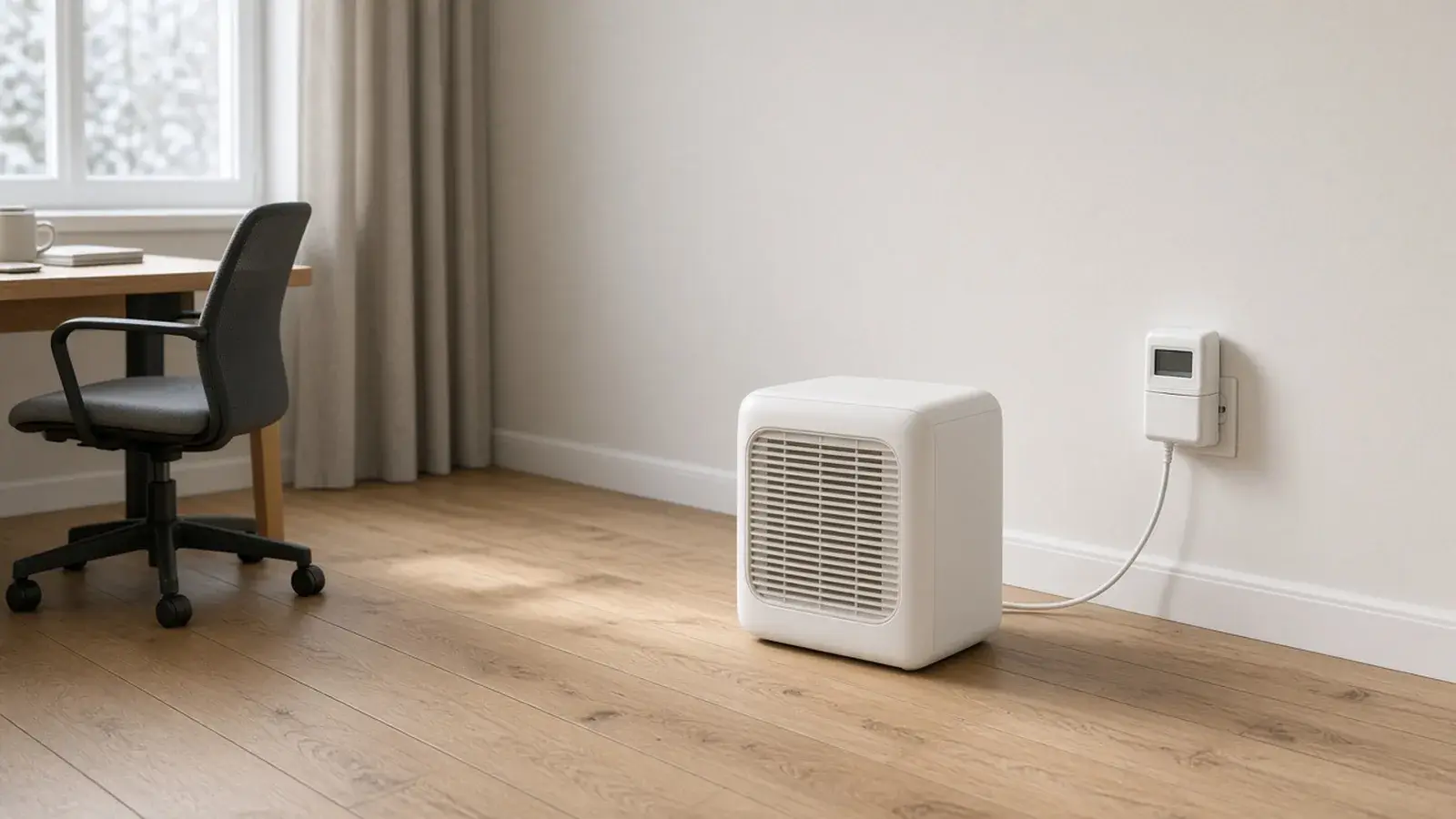
A fan heater is for short, targeted warming (e.g. the bathroom in the morning), not for heating a home. It uses up to 2 kWh per hour (at 2,000 watts). To use it safely: plug it straight into a wall socket, no extension leads or power strips, keep at least 1 metre clear of curtains, furniture and fabrics, never cover it, never leave it running unattended or overnight, and only use models with overheat and tip-over protection.
When a fan heater makes sense
Fan heaters are handy when you want warmth quickly and only briefly:
- 10–15 minutes in a cold bathroom in the morning (only with an approved model),
- in a hobby room or guest room that’s rarely used,
- as a stopgap when the heating has broken down, until it’s repaired.
As permanent heating for a home they’re expensive and put heavy load on sockets and wiring.
Work out the running costs
The formula is simple:
Power (kW) × hours of use × electricity price (per kWh) = cost
Example: a 2,000-watt (= 2 kW) heater runs 3 hours a day on full. That’s 6 kWh a day, around 180 kWh a month. For comparison, a one-person household often uses about 1,500–2,000 kWh of electricity a year in total. One month of fan heater can use as much electricity as several months of normal household use.
Multiply the kWh by the unit rate on your bill and you know your real cost. An energy monitor between socket and heater is even more accurate, as it measures actual use including thermostat pauses.
Cheaper ways to get warm: for your body, a heated throw or hot water bottle costs far less, see Cold home: stay warm and save on heating.
The 10 safety rules
- Straight into a wall socket, no power strips.
- At least 1 metre clearance from curtains, furniture, bedding, paper and clothes.
- Never cover it or dry anything on it.
- Never unattended, never overnight.
- Stand it firmly on the floor, not on chairs or furniture.
- Overheat and tip-over protection are a must, plus a recognised safety mark.
- Bathrooms only with approved heaters, well away from bath and shower.
- Don’t run cables under rugs or trap them.
- Take warning signs seriously: burning smell, hot plug, discoloured socket, flickering lights.
- Test your smoke alarms (press the test button).
How to recognise a good heater
- Thermostat that holds the room temperature instead of running flat out
- Overheat protection and automatic switch-off if tipped over
- Recognised safety marks and clear instructions
- For bathrooms: explicitly suitable (check the IP rating)
Don’t forget humidity
A fan heater warms the air but doesn’t remove moisture. If you use one to briefly warm a cold room, keep airing regularly, see How to ventilate and heat in winter.
Products that actually help
Ceramic (PTC) fan heater with overheat and tip-over protection
Ceramic fan heater with thermostat, overheat protection and automatic switch-off if it tips over.
Link coming soon (TODO: Amazon UK/US Associates ID)Plug-in energy monitor
Sits between socket and heater and shows consumption in kWh, so you can see what the heater really costs.
Link coming soon (TODO: Amazon UK/US Associates ID)Smoke alarm with 10-year battery
Essential in any home, and especially where portable heaters are used.
Link coming soon (TODO: Amazon UK/US Associates ID)Stop it happening again
- Check cable and plug before every use; don't use damaged heaters.
- Stand the heater on a firm, level floor, not on deep-pile rugs, beds or sofas.
- Dust the air inlet and outlet regularly (switched off and cooled down).
- No cable reels: if an extension is unavoidable, use a short one rated for the load and fully unwound.
- Switch off when you leave the room, not just to standby.
FAQ
How much does an hour of fan heater cost?
Calculate: power in kilowatts × hours × your electricity price per kWh. A 2,000-watt heater on full uses 2 kWh per hour. Your unit rate is on your electricity bill. If the thermostat cycles, real consumption is lower; an energy monitor shows the actual figure.
Is a fan heater cheaper than central heating?
Almost never. Direct electric heating turns 1 kWh of electricity into 1 kWh of heat, and electricity usually costs much more per kWh than gas or district heating. A heat pump produces several kWh of heat per kWh of electricity. For a short time in a small room a fan heater can make sense; as a replacement for heating, it doesn't.
Can I plug a fan heater into a power strip?
Better not. A fan heater draws a high current for a long time. Even if the strip is rated for it, a second appliance, a poor contact or an old strip can overheat. A wall socket is the safe choice.
Can I leave a fan heater on overnight?
No. Electric heaters shouldn't run unattended or while you sleep. For the night, pre-warm the bed with a hot water bottle or a heated blanket with auto shut-off.
Ceramic, convector, oil-filled radiator: what's the difference?
Ceramic (PTC) fan heaters warm quickly and directly with a fan. Convectors are quiet but slower. Oil-filled radiators store heat and release it evenly, but get very hot on the outside. Physically, all of them turn about 1 kWh of electricity into about 1 kWh of heat; none is an energy-saving miracle.
Related problems
Dehumidifier or Hygrometer: What Actually Helps Against a Damp Home?
Damp walls, wet windows, musty smell? How to measure humidity properly and tell when you really need a dehumidifier.
How to Ventilate and Heat in Winter to Prevent Mould
Short bursts of airing instead of tilted windows, the right temperature for each room and a simple daily routine to keep your home dry and warm.
Cold Feet, Cold Home: Stay Warm and Save on Heating
Heated throw, hot water bottle, draught excluder & co.: how to get warm at home without turning the heating right up. With safety tips.