
How to Descale a Kettle: 3 Methods That Actually Work
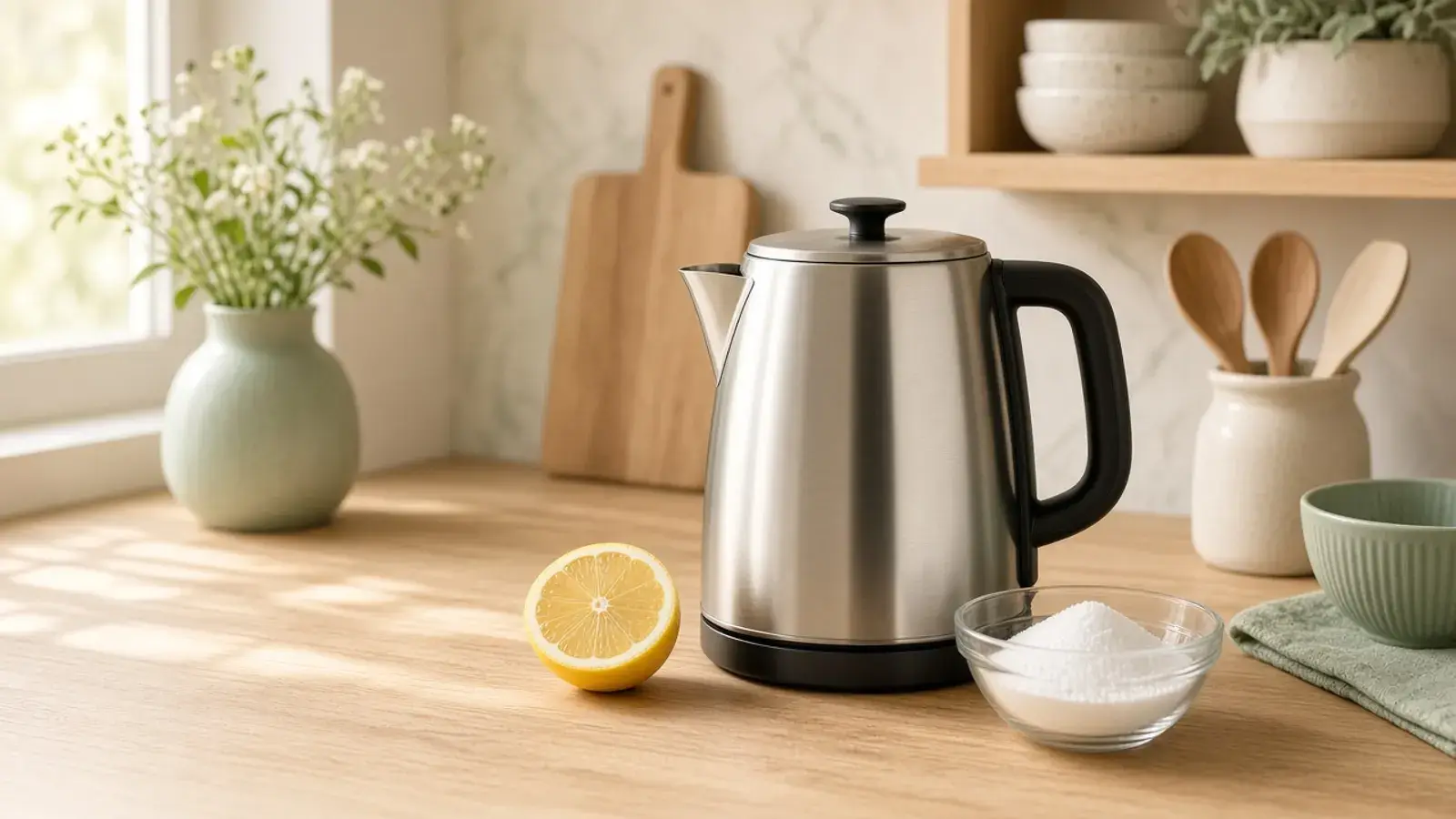
Citric acid works best: about 2 heaped tablespoons (roughly 25 g) per litre of water. Warm it, don't boil it, leave it for 20–30 minutes, pour away, rinse, then boil and discard one kettle of fresh water. In hard-water areas repeat every 2–4 weeks.
Why kettles scale up so fast
Tap water contains dissolved minerals, mainly calcium and magnesium. When you heat it, carbon dioxide escapes and some of those minerals drop out as limescale (calcium carbonate). It forms a white or brownish crust on the base and walls. The harder your water, the faster this happens. In hard-water regions, such as much of south-east England, you can see a layer after just a few weeks.
These habits speed it up:
- Leaving water in the kettle. Each time it cools and evaporates it leaves a film.
- Reboiling the same water again and again.
- Descaling rarely. Thick layers dissolve much more slowly than thin ones.
Method 1: citric acid (our pick)
Citric acid is odourless, food-safe and very effective.
- Fill the kettle half to two-thirds full (about 1 litre).
- Stir in 2 heaped tablespoons of citric acid powder (about 25 g).
- Only warm the water: switch the kettle off before it boils, or use a 50–60 °C setting if your kettle has one.
- Leave for 20–30 minutes, or longer for thick scale. Repeat if needed.
- Pour away, rinse, and wipe any loose bits with a soft sponge.
- Boil one kettle of fresh water and pour it away.
Why not boil it? At high temperature, calcium citrate can form. It is a hard-to-dissolve compound that sticks as a new layer.
Method 2: vinegar
Vinegar works reliably too, but it smells strongly.
- Mix white vinegar and water 1:1. With stronger cleaning vinegar, use about 1 part to 4 parts water.
- Warm it gently, without a rolling boil, and open a window.
- Leave for 30–60 minutes, pour away and rinse several times.
- Boil and discard fresh water two or three times to remove the taste.
Method 3: a commercial descaler
Liquid quick descalers often use a blend of acids and shift thick scale in minutes. Follow the dosage on the label exactly and rinse very thoroughly. This is worth it for very hard water or when you descale several appliances at once.
The three methods compared
| Method | Effectiveness | Smell | Effort | Best for |
|---|---|---|---|---|
| Citric acid | very good | none | low | regular descaling |
| Vinegar | good | strong | medium (rinse often) | when it’s all you have |
| Commercial descaler | very good, fast | low | low | thick scale, very hard water |
Common mistakes
- Boiling citric acid creates a new, stubborn layer.
- Scrubbing with steel wool scratches the surface, and scale then grips even faster.
- Not rinsing leaves your first cup tasting sour.
- Mixing cleaners, especially acid and bleach, is dangerous.
And the filter in the spout?
Many kettles have a removable mesh filter in the spout. Take it out and soak it in a glass of warm citric acid solution for 15 minutes, then brush it clean with an old toothbrush.
Products that actually help
Food-grade citric acid powder
Cheap, odourless and versatile. It also works on coffee machines, shower heads and taps.
Link coming soon (TODO: Amazon UK/US Associates ID)Liquid quick descaler for kitchen appliances
Ready to use, handy for thick scale or very hard water. Dose as stated on the label and rinse thoroughly.
Link coming soon (TODO: Amazon UK/US Associates ID)Water filter jug
Prevention: filtered water contains less carbonate hardness, so much less scale forms. Change the cartridge about every 4 weeks.
Link coming soon (TODO: Amazon UK/US Associates ID)Stop it happening again
- Don't leave water standing in the kettle. Empty it after use and leave the lid open to dry.
- Boil only what you need. It saves energy and limescale.
- In hard-water areas descale every 2–4 weeks. With soft water, every 2–3 months is enough.
- Use filtered water for tea and coffee.
- Your water supplier's website usually lists your local water hardness.
FAQ
Is limescale in a kettle harmful?
No. It is mainly calcium and magnesium carbonate and is safe to consume. But it spoils the taste, leaves flakes in your tea and makes the kettle slower, because scale insulates the element.
Why shouldn't I boil citric acid?
At high temperatures it can form poorly soluble calcium citrate, which settles as a new, stubborn layer. Warm water at around 50–60 °C is ideal.
Does bicarbonate of soda remove limescale?
Barely. Bicarbonate is alkaline and does not dissolve scale. Acids like citric acid or vinegar work far better.
How do I get rid of the vinegar smell?
Boil and discard fresh water two or three times, then leave the lid open. The smell is usually gone after that.
Related problems
Smelly Fridge? How to Find the Cause, Clean It and Keep It Fresh
Musty or rotten smell in the fridge? How to find the source, clean thoroughly including the drain hole, and keep it fresh with bicarbonate of soda and good containers.
Dehumidifier or Hygrometer: What Actually Helps Against a Damp Home?
Damp walls, wet windows, musty smell? How to measure humidity properly and tell when you really need a dehumidifier.
How to Ventilate and Heat in Winter to Prevent Mould
Short bursts of airing instead of tilted windows, the right temperature for each room and a simple daily routine to keep your home dry and warm.