
Personal alarms on the go: benefits and limits
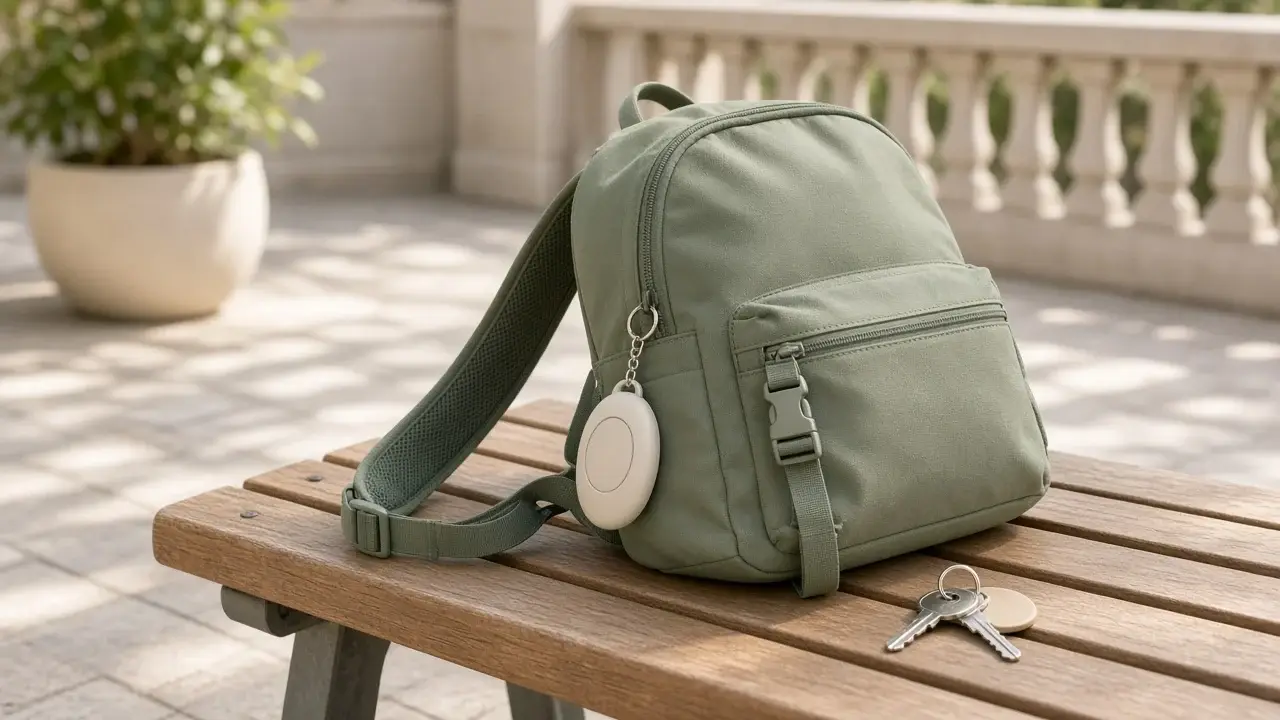
A personal alarm produces a loud sound that may attract the attention of people nearby. It does not guarantee help or protection. Accessible placement, understandable controls and a reliable power supply matter more than the biggest advertised decibel number. An ordinary sound-only alarm does not automatically call the police or send your location.
Image disclosure: AI-generated symbolic illustration. The generic device shown is not either product discussed below and does not document a product test.
What a sound alarm is for
A personal or keyring alarm is intended to draw attention through a conspicuous noise. German police crime-prevention guidance mentions shrill alarms as a possible alternative to carrying weapons, particularly when other people are nearby. This is not a promise that someone will leave you alone or that bystanders will intervene.
An adult might carry one on a keyring or an accessible bag attachment. In an empty area, behind closed windows or amid heavy background noise, the hoped-for response may not happen. We do not claim a guaranteed audible range.
What it cannot replace
A basic sound alarm does not locate you or independently contact parents, police or an ambulance. Some other devices add connected functions; these need to be checked explicitly.
Police advice emphasises noticing your surroundings, creating distance early, moving to a safe place such as a shop, and addressing a specific bystander: “You in the green jacket, please help and call the police.” An alarm can only supplement those options. It is not a reason to take additional risks.
Five checks before choosing
- Access: can you reach it with your usual bag and clothing? Is the attachment secure and practical?
- Controls: do you understand both activation and stopping? Pull pins and buttons differ between models. Use the instructions for the delivered variant rather than copying a promotional video.
- Power: rechargeable devices need charging; replaceable batteries need the correct type and installation. Follow the maker’s instructions. We do not invent a universal service interval.
- Everyday handling: consider accidental activation and documented moisture resistance. Do not assume waterproofing without evidence.
- Clear documentation: look for identifiable models and understandable instructions. An advertised decibel figure without measurement conditions is not independent evidence of quality or protection.
Hearing safety matters
Germany’s Environment Agency explains that brief high sound peaks can cause permanent hearing damage. Do not test an alarm beside an ear, aim it at people or use it to frighten someone. A product advertisement is not enough to establish a universally safe distance or duration.
First learn the controls without sounding the device. If the manual calls for a function test, follow its safety directions and avoid unnecessary noise exposure. Seek medical advice for persistent symptoms after loud noise.
For parents: understanding comes first
There is no blanket claim that a personal alarm is suitable for children. Follow manufacturer guidance and consider whether a child can reach, understand and stop the device. Practise handling without sounding it first, and discuss trusted adults and places to seek help.
The child should not feel solely responsible for their safety. A device replaces neither age-appropriate supervision nor agreed routines. Loose parts and batteries can present additional risks for younger children. If the selected device uses button batteries, secure the compartment and keep spare and used batteries inaccessible. The German Federal Institute for Risk Assessment advises immediate assessment in a children’s hospital or emergency department if button-battery swallowing is suspected. This general warning does not establish the battery type used by either model below.
Two examples, not a tested ranking
The German edition lists the blue TECKNET AF-2004 and the black ERABOS T1000 STANDARD, not the Ladies variant. These are concrete examples, not winners of a hands-on comparison. We have not measured their sound levels, protective effect or reliability.
The AF-2004 offer advertises USB-C charging, light functions and ring/button activation. Its exact original manual has not been independently verified; confirm how to stop the delivered unit. Do not transfer specifications between ERABOS variants. Check the current offer, warnings and manual for equipment and included items. No UK or US affiliate purchasing links are provided here.
Sources
- German police crime prevention: violence in public – behaviour advice and context for personal alarms (German).
- German Environment Agency: hearing damage – loud sound and brief peaks (German).
- German Federal Institute for Risk Assessment: button batteries – swallowing risks (German).
- Product context: Amazon offers checked on 8 November 2026 for ASIN B0D8J78PCZ and ASIN B07W1YJ65R. Seller claims are not independent test results. Authority sources accessed on the same date.
Stop it happening again
- Attach the alarm where you can reach it without searching, not at the bottom of a bag.
- Check power, casing and attachment following the manufacturer's instructions, including after activation.
- Learn both activation and stopping for the exact model. Only perform sound tests in accordance with its instructions and hearing precautions.
- Discuss trusted people, safe places and how to ask for help with children. An alarm does not replace that plan.
FAQ
Does a personal alarm automatically call for help?
Not an ordinary sound-only alarm. It makes noise; whether anyone responds is uncertain. Only expect GPS, mobile connectivity or automatic calls if these are explicitly documented for the device.
Is an alarm suitable for every child?
No. Consider manufacturer guidance and whether the child can reach, understand, activate and stop the device. It is not a toy or a substitute for supervision and a safety plan.
Does a higher decibel claim mean greater safety?
No. Advertising figures without comparable measurement conditions are not evidence of protection. More noise guarantees neither attention nor help and can threaten hearing.
What if it goes off accidentally?
Use the stopping procedure you learned for the exact model; do not bring it near ears. Then check its power supply and attachment as instructed. There is no universal stopping method.
Related problems
Fire Extinguisher for Your Home: Which Type for the Kitchen, Hallway and Garage?
Foam, powder or a class F extinguisher for fat fires? How to choose the right fire extinguisher for your home, check for EN 3 and keep it serviced.
Smoke Alarm Chirping: What the Signal Means and When to Replace It
A short chirp every few seconds or minutes? How to tell whether the battery is low, the alarm is faulty or it needs replacing after 10 years.
Carbon Monoxide Alarm: Where to Fit It and How It Differs From a Smoke Alarm
You cannot smell carbon monoxide. How to choose a CO alarm to EN 50291, fit it in the right place and respond correctly when it goes off.