
Fire Extinguisher for Your Home: Which Type for the Kitchen, Hallway and Garage?
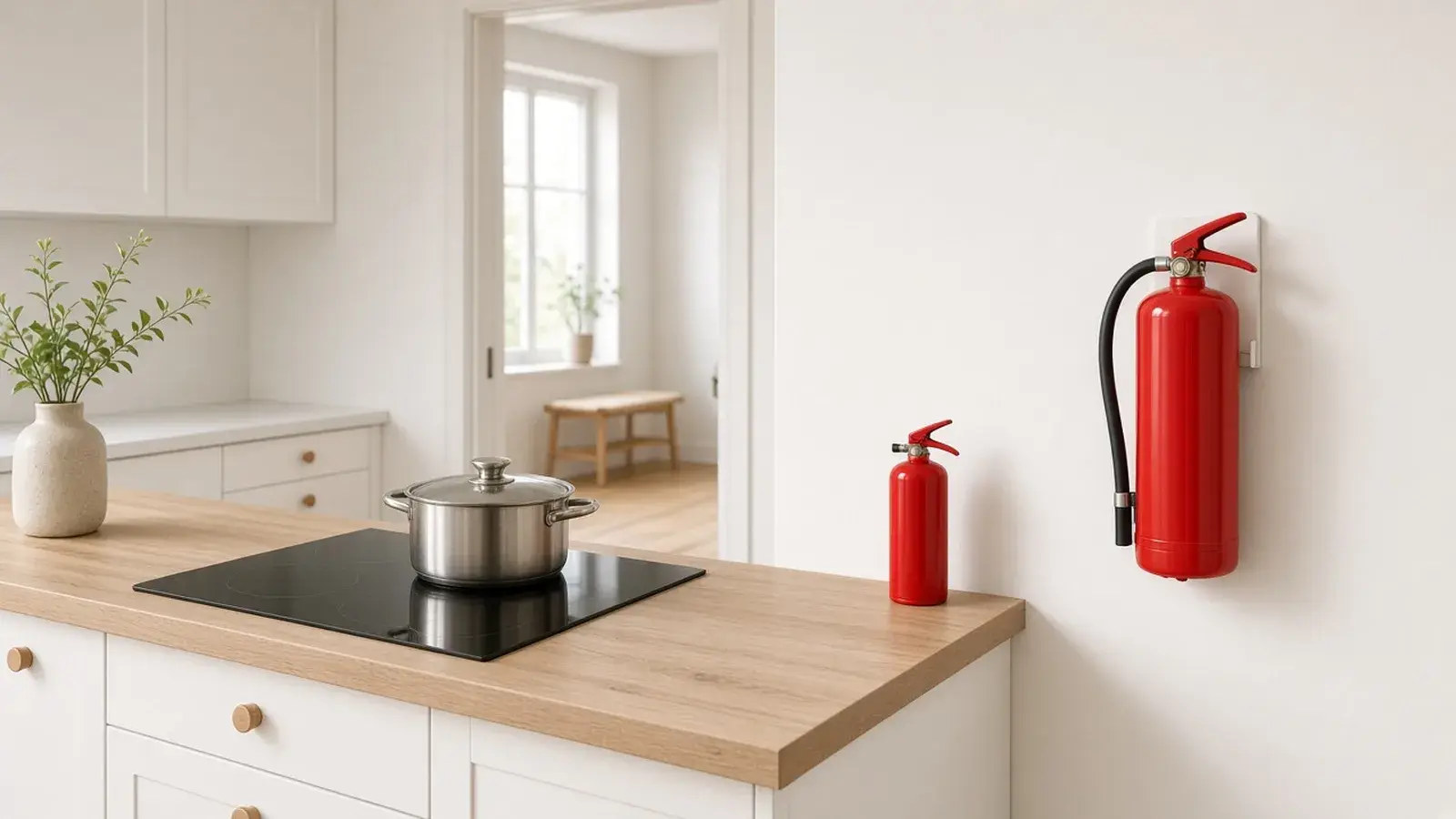
For living areas, the German motoring club ADAC recommends a foam extinguisher, and for the kitchen an extinguisher rated for class F fires (burning cooking oil and fat). Powder extinguishers (ABC) are better suited to the garage and workshop, because powder causes a lot of damage indoors. Look for EN 3, choose a fluorine-free foam and have it serviced every 2 years. Never use water on burning fat.
Fire classes in brief
| Class | What is burning | Examples |
|---|---|---|
| A | Solids | Wood, paper, textiles |
| B | Liquids | Petrol, paint, solvents |
| C | Gases | Propane, natural gas |
| F | Cooking oils and fats | Oil in a pan or fryer |
The label shows which classes the extinguisher is suitable for.
Which extinguisher where?
- Living areas and hallway: foam extinguisher for classes A and B. It puts out furniture and textiles and leaves little damage.
- Kitchen: extinguisher or spray rated for class F. Water makes burning fat explode.
- Garage, workshop, cellar with an oil tank: ABC powder extinguisher.
What to look for when buying
- EN 3 and a CE mark on the label.
- 6 to 9 kg or litres of extinguishing agent for a home.
- Fluorine-free foam. ADAC recommends it. Foams containing fluorine contain PFAS, which barely break down in the environment.
- A manufacturing date less than a year old.
- A wall bracket included.
How to use it
- Pull the safety pin.
- Keep any wind at your back and a clear escape route behind you.
- Work from front to back and from the bottom up.
- Use short, targeted bursts rather than one long spray.
- Keep watching the area afterwards. Embers can flare up again.
Read the instructions on the label before you need the extinguisher.
Servicing and disposal
Fire extinguishers should be checked by a specialist every 2 years. In Germany ADAC puts this at about 25 to 45 €. A used extinguisher must be refilled or replaced, even if it was only used briefly. Take old extinguishers to a recycling centre.
An extinguisher only helps if you notice the fire early. That is what smoke alarms are for.
Sources
- ADAC: Fire extinguishers for the home (German, 11 Nov 2025, accessed 3 Nov 2026)
Products that actually help
6 litre fluorine-free foam extinguisher to EN 3
For living rooms, hallways and cellars. 6 litres is within the range ADAC recommends.
Link coming soon (TODO: Amazon UK/US Associates ID)Class F extinguisher for the kitchen
Small extinguisher for burning oil and fat in a pan or fryer.
Link coming soon (TODO: Amazon UK/US Associates ID)Fire extinguishing spray rated for classes A and F
For small fires that are just starting. It does not replace a proper extinguisher.
Link coming soon (TODO: Amazon UK/US Associates ID)Stop it happening again
- Hang the extinguisher where you can see it, near the front door or the kitchen, not in a cupboard.
- Have it serviced every 2 years. In Germany ADAC puts the cost at about 25 to 45 €.
- When buying, check the manufacturing date. It should be less than a year old.
- Never leave candles or pans with oil unattended.
- Take old extinguishers to a recycling centre.
FAQ
Is a fire extinguisher required in a private home?
In Germany, no. Smoke alarms, on the other hand, are required in every federal state.
What size should the extinguisher be?
ADAC recommends 6 to 9 kg or litres for a home. A 2 kg extinguisher empties quickly. What matters is that you can still hold it comfortably.
Why not a powder extinguisher indoors?
Powder puts fires out well, but it spreads through the whole home and gets into appliances and furniture. The damage from the powder is often greater than from a small fire.
Does a fire blanket help with a fat fire?
Fire blankets performed poorly in a test by the German consumer testing body Stiftung Warentest. A better option: switch off the hob and put a lid that fits on the pan. For the kitchen, an extinguisher or spray rated for class F is suitable.
How do I recognise a good extinguisher?
By EN 3, the CE mark and the fire classes on the label. The number before the letter, such as 21A, shows the extinguishing power. Higher is better.
Related problems
Personal alarms on the go: benefits and limits
What a personal sound alarm can and cannot do, with practical advice on access, controls, hearing safety and choosing one for an older child.
Smoke Alarm Chirping: What the Signal Means and When to Replace It
A short chirp every few seconds or minutes? How to tell whether the battery is low, the alarm is faulty or it needs replacing after 10 years.
Carbon Monoxide Alarm: Where to Fit It and How It Differs From a Smoke Alarm
You cannot smell carbon monoxide. How to choose a CO alarm to EN 50291, fit it in the right place and respond correctly when it goes off.