
Countertop reverse osmosis filters: who they help and what to check
A countertop reverse osmosis unit is not usually a health necessity in Germany. Tap water here is of very good quality. A freestanding unit can still make sense if taste matters to you, if your water is very hard and you want less limescale in the kettle or coffee machine, or if you want to stop lugging bottles. Before you buy, check the wastewater ratio, filter replacement costs, power draw and footprint, whether the unit uses a tank or dispenses on demand, and whether remineralisation and independent certification are documented.
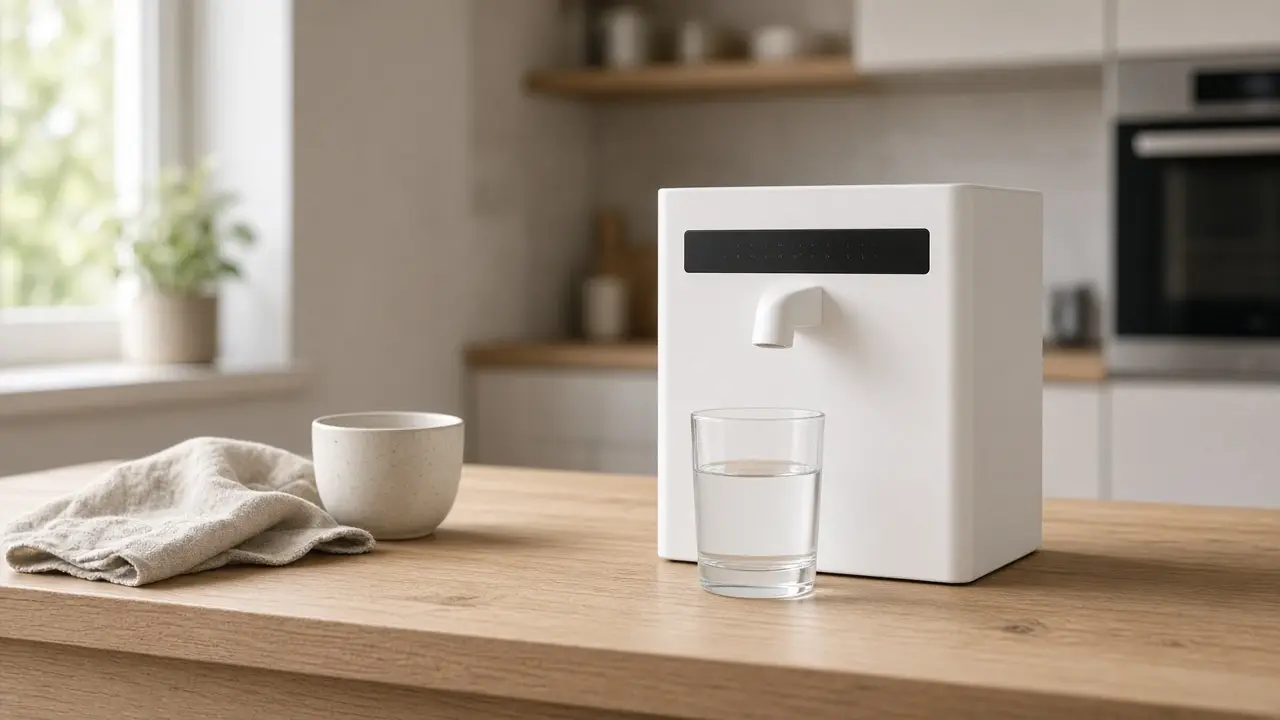
Image disclosure: AI-generated symbolic illustration. The generic unit shown is not any of the products discussed below and does not document a product test.
First: tap water in Germany is usually very good
A countertop reverse osmosis unit does not fix a nationwide quality problem. The Federal Environment Agency states that drinking water in Germany is of very good quality and can, almost without exception, be drunk without concern. More than 99 percent of measured values meet the requirements of the Drinking Water Ordinance. The Federation of German Consumer Organisations concludes that there is no health need for extra treatment, even when the water is hard.
If you want to know what comes out of your own tap, your water supplier publishes the analysis data. The last metres of pipe inside the building are the owner’s responsibility.
Who can still benefit
The value lies mainly in taste and daily convenience, not in a supposed necessity.
Taste. Some people prefer very low-mineral water, others do not. That cannot be predicted in general. Some units add minerals after the membrane so the water does not taste flat.
Very hard water and limescale. Under Germany’s detergent law, water with more than 2.5 millimoles of calcium carbonate per litre is classed as hard. According to the German technical association DVGW, high hardness can cause troublesome scale in water-heating appliances. Because reverse osmosis reduces calcium and magnesium, treated water can leave less deposit in a kettle, jug or espresso machine. That applies only to the water from the unit.
Coffee and tea. Many people buy a unit for exactly this reason: less scale in the machine and a different taste in the cup. Whether you like the result is a personal judgement.
Fewer water crates. If you currently carry and store bottled water, a countertop unit can cut that effort. According to the Federal Environment Agency, plain tap water is already the cheapest and most environmentally friendly drink, and it creates far less environmental burden than bottled mineral water. A reverse osmosis unit can spare you the lifting, but it uses extra water as concentrate and needs electricity.
A brief note on old lead pipes. Some buildings erected before 1973 may still contain lead pipes, but many do not. Since 12 January 2026 such pipes, including short sections, must be removed or taken out of service. The Federal Environment Agency does not consider filters a sensible way to remove lead. A unit sitting on the worktop does not replace that replacement work.
How reverse osmosis works, in brief
Water is forced under pressure through a very fine membrane. Water molecules pass through; many dissolved substances are held back. Two streams result: treated water and a concentrate that leaves the unit as wastewater. Extra filters often sit before and after the membrane, for particles or taste.
The US CDC notes that reverse osmosis can reduce, among other things, calcium, magnesium, nitrate, fluoride, copper and lead. What a specific unit actually does belongs on the label, in the data sheet and, preferably, in an independent certification. Manufacturer claims alone are not a test result.
Countertop units usually need no change to the household plumbing. Typically you fill a reservoir with tap water. Some models store treated water in a tank or jug; others produce it only when you dispense it.
What to check before you buy
Wastewater ratio. According to the US Environmental Protection Agency, a typical point-of-use system sends five gallons or more of concentrate down the drain for every gallon of treated water. Newer units can operate with one or two gallons of concentrate per gallon treated. A higher efficiency rating means a larger share of the feed water becomes treated water. German listings often state a ratio such as 3:1 treated water to wastewater, meaning three parts treated water to one part concentrate. Check that this is the meaning used and under what conditions the figure applies. Until it is independently confirmed, it remains a manufacturer claim.
Filter costs. Cartridges have to be changed on a schedule. The German consumer organisation points out that spent filters can release retained substances back into the water. Budget for filters, and for mineral packs if needed, over several years, not only for the purchase price.
Electricity. Units with instant heating or cooling need a power socket. Power draw during heating can be high. The Philips 6500 listing states a rating of 2100 W. Without our own measurement we do not state an annual consumption figure.
Space and weight. Measure the worktop, including clearance under wall cupboards. Figures from the listings we checked: LANGWATER TheWell 2 at 35 × 21 × 47 cm and 9 kg, and the Philips 6500 at 42.6 × 21.1 × 39.8 cm (depth × width × height) and 12.3 kg. The Waterdrop A2 listing on the day we checked did not state the cabinet dimensions.
Tank or on-demand flow. A storage tank or jug gives water immediately, but it needs cleaning. For tank systems the EPA recommends, among other things, regular emptying and following the manufacturer’s hygiene instructions. Tankless, on-demand flow avoids stored treated water, but dispensing can be slower. For TheWell 2 the supplier states 1 litre in 2.5 minutes.
Remineralisation. After the membrane the water is low in minerals. Some units add back calcium, magnesium or other salts, often for taste. Check whether this is built in or sold as a separate consumable.
Certification. NSF/ANSI 58 is the relevant standard for point-of-use reverse osmosis drinking-water systems. It covers, among other things, the reduction of dissolved solids and stated efficiency and recovery. Extra contaminant claims are optional and must be evidenced individually. A logo on the box is not a substitute for checking the official NSF listing, and certification of a membrane alone is not automatically certification of the complete unit. For permanently installed systems the German consumer organisation refers to DVGW or DIN marks. A freestanding countertop unit that does not alter the building’s drinking-water installation is assessed under different rules than a change to that installation.
Running costs, stated plainly
On top of the purchase price come filters, possibly mineral packs, electricity, and the extra water used as concentrate. Examples from the amazon.de listings checked on 11 November 2026, each of them a supplier claim and not a long-term test by us:
- Waterdrop A2: unit 379.00 €. The matching A2RF replacement filter was listed at 69.99 €, with a title stating 12 months.
- LANGWATER TheWell 2: unit 489.00 €. Mineral packs must, according to the listing, be bought separately. A two-year interval for the RO stage is a manufacturer claim.
- Philips 6500: unit 556.44 €. Two cartridges, ADD541/10 and ADD547/10, are each specified in the listing for 2000 l.
Prices change. Check current filter prices and what is in the box before you buy.
Drawbacks you should know
- Tap water in Germany is usually already fine to drink. The unit is optional.
- Concentrate is produced. That raises water use compared with drawing water straight from the tap.
- Filters and any mineral packs create ongoing costs.
- Electricity use is greatest when the unit heats or cools water.
- The unit occupies worktop space permanently.
- Tanks and jugs have to be kept clean.
- Very low-mineral water tastes empty to some people. Without documented remineralisation that can be unwelcome.
- A countertop unit does not change the water at the shower, washbasin or dishwasher.
- We have not tested the models named below ourselves. Contaminant, efficiency and hygiene figures in the listings are not independent test results.
Three example models, not a ranking
The following amazon.de offers are concrete countertop units that do not need a fixed water connection. The selection is not a comparative test and not a league table. Current features, warnings, contents and prices are in each listing and in the instructions. The German version of this article contains the affiliate product links.
The Waterdrop A2 is the least expensive of the three examples and, according to the listing, dispenses hot and cold water at a stated ratio of 3:1. You should confirm before buying whether a German or English manual is supplied; the listing said the manual might not be in German. TheWell 2 emphasises adjustable mineralisation and a higher stated efficiency, but it requires separate mineral packs. The Philips 6500 comes from an established brand, is sold by Amazon itself, and combines heating and cooling; at 2100 W and just over 42 cm deep it needs space and a suitable socket.
Sources
- German Environment Agency: drinking water from the tap: tap-water quality, cost and environmental comparison with bottled water, note on lead pipes. Last updated 23 April 2026, retrieved 11 November 2026.
- German Environment Agency: drinking-water quality data: report for 2020 to 2022, compliance with limit values. Retrieved 11 November 2026.
- Verbraucherzentrale: household water treatment: no health need for extra treatment, filter changes. As of 17 November 2025, retrieved 11 November 2026.
- German Environment Agency: lead pipes in drinking water: removal or decommissioning; filters not a sensible remedy. Last updated 4 August 2026, retrieved 11 November 2026.
- Section 17 of the German Drinking Water Ordinance: deadline for removing or decommissioning lead pipes. Retrieved 11 November 2026.
- CDC: About Home Water Treatment Systems: how reverse osmosis works and possible reduction of dissolved substances including calcium and magnesium. As of 10 April 2024, retrieved 11 November 2026.
- EPA WaterSense: Treating Water With Less Waste (PDF): how concentrate is produced, typical and more efficient wastewater ratios, tank and countertop units, maintenance. November 2024, retrieved 11 November 2026.
- NSF: NSF/ANSI 58 Reverse Osmosis Drinking Water Treatment Systems: scope of the standard, required and optional claims. 18 December 2025, retrieved 11 November 2026.
- NSF product listings for Standard 58: official certified-product list, retrieved 11 November 2026.
- DVGW: water hardness: hardness ranges and technical drawbacks of high hardness. Retrieved 11 November 2026.
- Section 9 of the German Detergents Act (WRMG): statutory hardness ranges soft, medium and hard. Retrieved 11 November 2026.
- Product details: amazon.de listings checked on 11 November 2026 for Waterdrop A2 (ASIN B0DGLCV3B6), replacement filter A2RF (ASIN B0DGPXF2S8), LANGWATER TheWell 2 (ASIN B0DXM6HZWR) and Philips 6500 ADD6912BK/10 (ASIN B0F2JB3VPF). Supplier claims are not independent test results.
Stop it happening again
- Before buying, check space, weight, a power socket and how you will handle the concentrate. Exact dimensions are in each product listing.
- Order replacement filters, and mineral packs if needed, in good time. Follow the change intervals in the instructions for the exact model.
- If the unit has a tank or jug, clean it as instructed.
- Treat only the water you need for drinking and cooking. Other household uses do not need this treatment.
- Your water supplier must tell you the hardness range at least once a year. It is often on the supplier's website or on the bill.
FAQ
Do I need one of these because tap water is unsafe?
In Germany, usually no. The Federal Environment Agency (Umweltbundesamt) describes drinking-water quality as very good. The Federation of German Consumer Organisations sees no health reason for extra treatment. A countertop unit can still be of interest for taste, convenience or very hard water.
Does reverse osmosis help with limescale?
The membrane reduces dissolved substances, including the calcium and magnesium that make water hard. Treated water can therefore leave less scale in a kettle or coffee machine. The building's plumbing and other taps are unchanged.
Is a filter enough if the building still has lead pipes?
No. Lead pipes, including short sections, must be removed or taken out of service under the German Drinking Water Ordinance. The Federal Environment Agency says filters are not a sensible way to deal with lead. Owners are responsible; tenants should contact the landlord or the local health authority.
Is the treated water healthier?
We do not make that claim. Reverse osmosis reduces many dissolved substances, including minerals. Some units then add minerals back, mainly for taste. Whether that suits you is a matter of taste and convenience, not a health promise.
Related problems
How to Descale a Kettle: 3 Methods That Actually Work
White crust and flakes in your tea? How to descale a kettle with citric acid, vinegar or a descaler, plus the mistakes to avoid.
Smelly Fridge? How to Find the Cause, Clean It and Keep It Fresh
Musty or rotten smell in the fridge? How to find the source, clean thoroughly including the drain hole, and keep it fresh with bicarbonate of soda and good containers.
The gift your child asked for is sold out or looks unsafe: what you can still do
When the gift your child wants is sold out or looks unsafe: check age marks, small parts and the seller, and find a timely alternative.