
Plug-in Solar With a Battery: AC or DC, What Is the Difference?
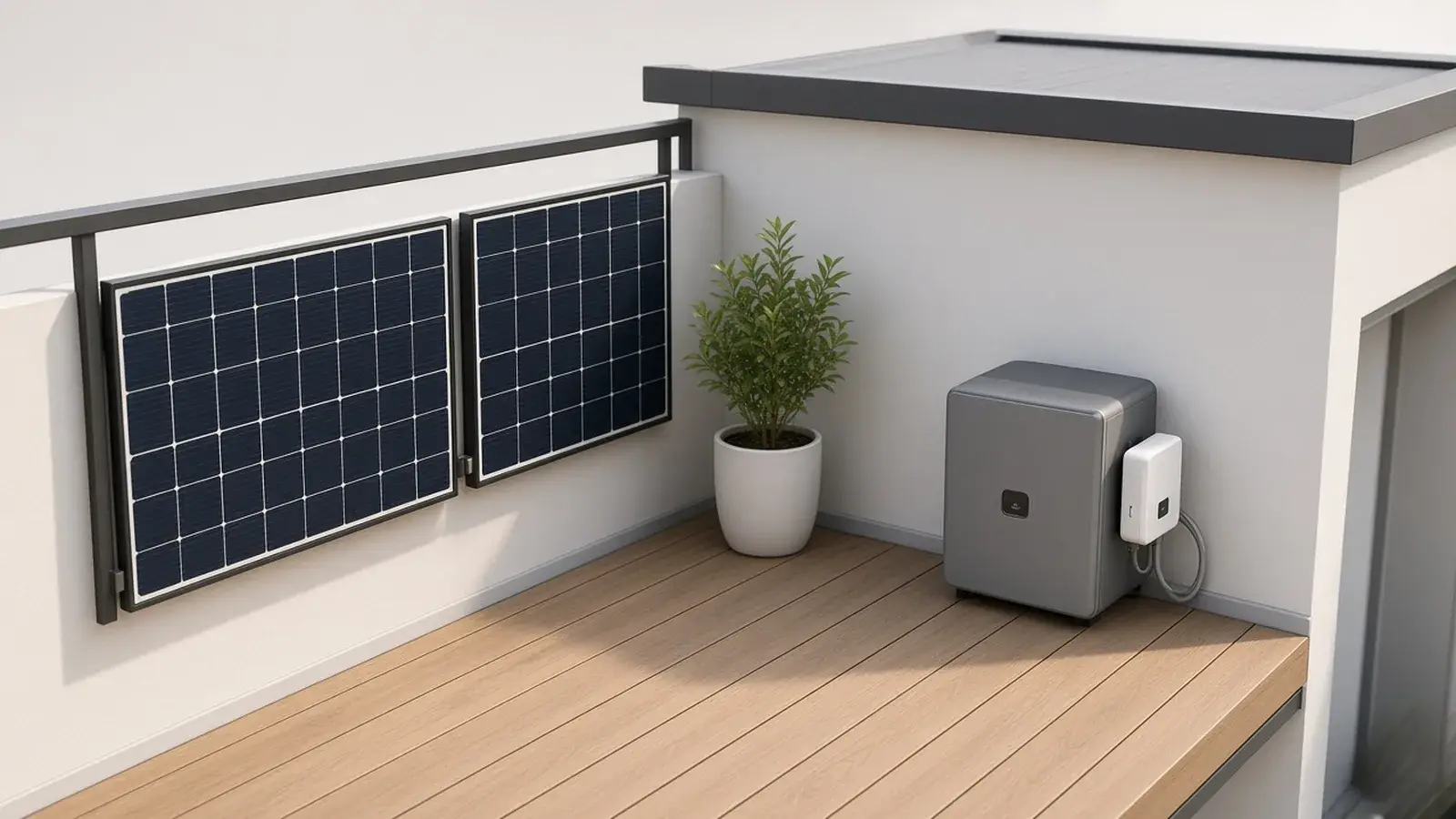
A DC battery sits between the solar panels and the inverter. It charges straight from the panels' direct current and is usually the simpler choice for a new plug-in solar kit. An AC battery plugs into a socket and charges with alternating current. It can be added to an existing kit, but the power is converted twice. In Germany the limits are 800 VA output and 2,000 Wp of panels, and the battery must be registered too. In Great Britain, plug-in kits of up to 800 W have been legal since 27 August 2026.
How the two types work
DC battery (direct current)
- Sits between the solar panels and the inverter.
- Charges straight from the panels’ direct current.
- Many have a built-in inverter. They then replace your old one or work without a separate one.
- A good fit for a new kit.
AC battery (alternating current)
- Connects to your home’s wiring through a socket.
- Charges with the power your solar kit feeds into the home.
- Can be added to an existing kit without changing the panel wiring.
- Usually needs a smart meter or meter clamp so it knows when to charge and discharge.
The rules in Germany
- no more than 800 VA output at the inverter,
- no more than 2,000 Wp of panels,
- registration in the Marktstammdatenregister (the federal register), including the battery.
The standard DIN VDE V 0126-95 has applied since 1 December 2025 to devices without a battery. It allows a Schuko socket up to 960 Wp of panels. Above that, a Wieland socket fitted by an electrician is required.
The rules in Great Britain
Since 27 August 2026, plug-in solar kits of up to 800 W have been legal to buy and use across Great Britain. The government says to check whether you need permission first. That can mean your landlord, building owner or freeholder, planning permission or listed building consent. Any change to your circuits is a job for a qualified electrician.
Which type suits you?
| Situation | Better suited |
|---|---|
| New kit with a battery | DC battery with built-in inverter |
| Existing kit, keeping the inverter | DC battery that matches the inverter, or AC battery |
| High consumption, several generators, professional installation | AC battery with smart meter |
What only an electrician should do
- check the circuit and fuse,
- fit a dedicated socket,
- any work in the fuse box, such as a meter clamp or a separate circuit,
- permanently install devices with more than 800 W output.
Before you choose a battery size, measure your base load. Whether a battery pays off is covered in Is a battery worth it?.
Sources
- VDE FNN: Plug-in PV systems (German, 3 Mar 2026, accessed 3 Nov 2026)
- Verbraucherzentrale: Plug-in solar (German, 24 Jul 2026)
- ADAC: Plug-in solar with a battery (German, 17 Sep 2026)
- Bundesnetzagentur: Marktstammdatenregister FAQ (German)
- GOV.UK: Households can save as plug-in solar panels come to market (26 Aug 2026)
Products that actually help
DC balcony battery with built-in micro-inverter (about 1.6 kWh)
The panels connect directly and the output is limited to 800 W. A simple choice for a new kit.
Link coming soon (TODO: Amazon UK/US Associates ID)DC balcony battery with several MPPT inputs (about 1.9 kWh)
For several panels. Also has a built-in inverter.
Link coming soon (TODO: Amazon UK/US Associates ID)Stop it happening again
- Measure your base load first, then choose the battery size.
- Size the battery using the rule of thumb from HTW Berlin: no more than 1.5 kWh per kWp of panels.
- Before buying, check whether your inverter works with the battery.
- Place the battery within the manufacturer's temperature range, protected from direct sun and frost.
- Check the rules where you live: registration in Germany, permissions from landlord, freeholder or council in Great Britain.
FAQ
Which type is more efficient?
A DC battery charges straight from the panels' direct current. An AC battery first gets alternating current, converts it back to direct current to charge, and back to alternating current when it discharges. Each conversion loses some energy.
Can I add a battery to my existing kit?
Yes, with either type. Many DC batteries go between the panels and your existing inverter. An AC battery connects through a socket. In both cases, check that the manufacturer approves your combination.
Can I feed in more than 800 W if I have a battery?
In Germany, no. The 800 VA inverter limit still applies with a battery. Devices that can deliver more must be limited to 800 W or be permanently installed by a qualified electrician. In Great Britain, plug-in kits are also limited to 800 W.
Is a normal socket enough?
In Germany, the standard DIN VDE V 0126-95 allows a normal Schuko socket for kits without a battery up to 960 Wp of panels. Above that, an electrician must fit a dedicated Wieland socket. In Great Britain, use only kits on the government's list of compliant devices and follow their instructions. If in doubt, have an electrician check.
How big should the battery be?
ADAC gives 1 to 4 kWh for typical kits. HTW Berlin recommends no more than 1.5 kWh per kWp of panels. With 0.8 kWp of panels, that is about 1.2 kWh.
Related problems
Is a Battery Worth It for Plug-in Solar? An Honest Calculation
A battery increases your savings but costs more. Use ADAC's example calculations to check whether it pays off for your household.
Measure Your Base Load: Find Out How Much Power Your Home Uses Overnight
Your base load decides how big a plug-in solar battery should be. How to measure it with your electricity meter, a plug-in monitor or an optical reader.
Weak Car Battery in Winter: Test, Charge and Jump-Start
Car struggling to start in the cold? How to test the battery, charge it properly and jump-start in the correct order.