
Weak Car Battery in Winter: Test, Charge and Jump-Start
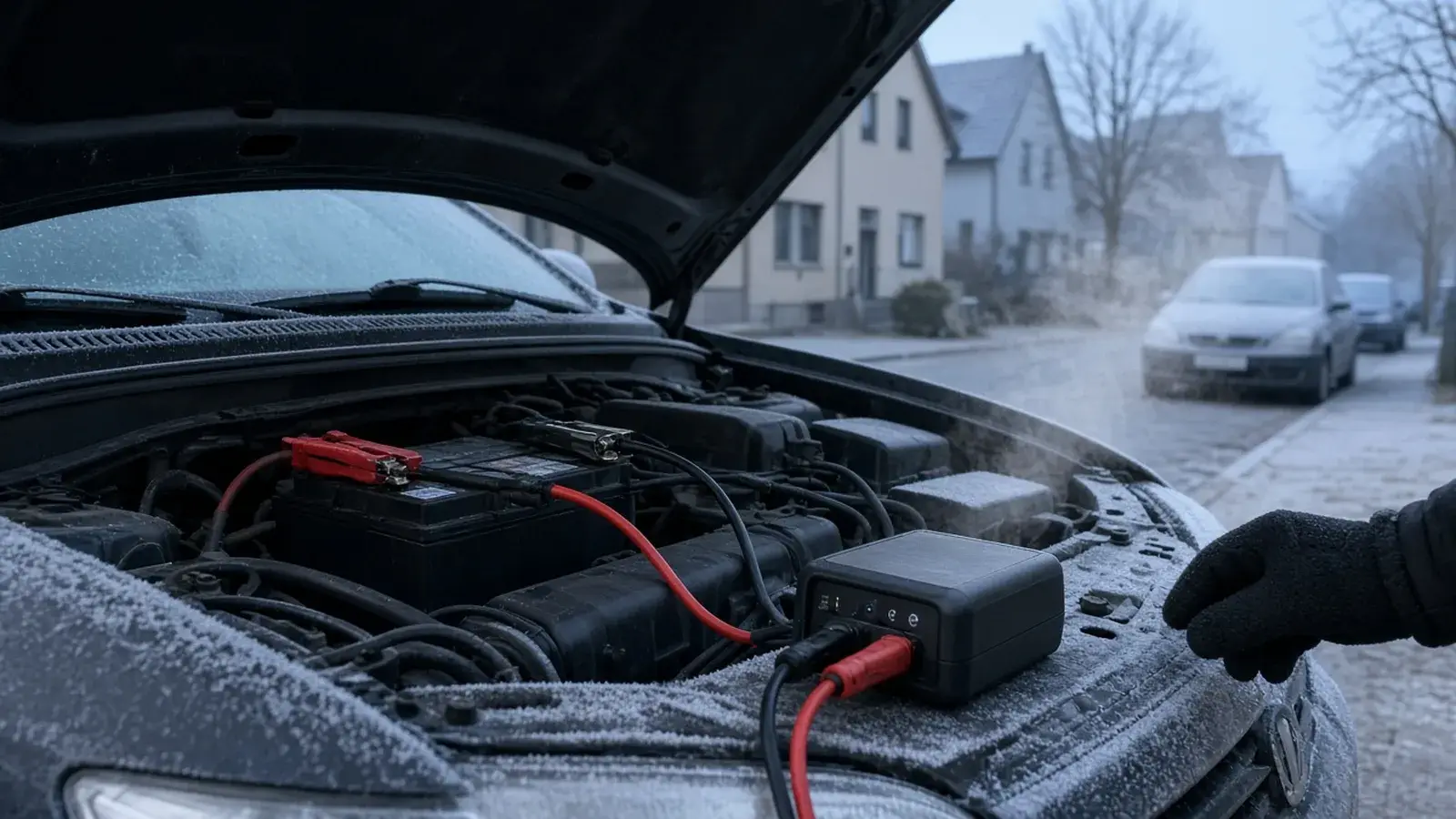
Cold weakens every battery: it delivers less current just when the cold engine needs more. Measure the resting voltage (after the car has stood for a few hours): about 12.6 V or more = full, around 12.4 V = top it up, below 12.2 V = significantly discharged. Before winter, charge it fully with a smart charger. To jump-start: red lead first to + on the flat battery, then to + on the donor; black lead to − on the donor, then to bare metal in the engine bay of the broken-down car, not to its battery's negative terminal.
Signs of a weak battery
- The starter turns slowly and laboriously, especially on frosty mornings.
- Dashboard lights dim noticeably while starting.
- Stop-start no longer switches the engine off (it saves power when the battery is weak).
- The battery warning light comes on or electronics act up when starting.
- All you hear is a click when you turn the key.
Test the battery
With a simple multimeter you can measure the resting voltage. The car should have stood for a few hours, ideally overnight, with all loads off.
| Resting voltage (approx.) | State of charge | What to do |
|---|---|---|
| 12.6 V or more | full | all good |
| around 12.4 V | about three-quarters | top up |
| around 12.2 V | about half | charge soon; frost starts likely to be a problem |
| below 12.0 V | heavily discharged | charge now, have it tested |
These are guide values for conventional lead-acid batteries; AGM and EFB are similar. Voltage only tells you the state of charge, not the remaining capacity. Whether a battery is worn out only shows in a load test at a garage.
Charge the battery properly
- Choose a suitable charger: an automatic 12 V charger that supports your battery type (lead-acid, EFB or AGM on stop-start cars).
- Ignition off, all loads off, key out.
- Red clamp to + (positive), then black clamp to − (negative) or the earth point named in the manual.
- Only now plug into the mains and choose the right mode.
- Afterwards: unplug from the mains first, then remove black, then red.
A maintenance charger can stay connected for weeks on cars that are rarely used in winter; it only tops up when needed.
Jump-starting with leads: the correct order
Preparation: Position the cars so the leads reach but the cars don’t touch. Ignition, lights and loads off in both cars. Hazard lights and hi-vis vest if you’re at the roadside. Take a look at the flat battery: if it’s swollen, leaking or frozen, don’t jump it.
Connecting:
- Red lead to the positive (+) terminal of the flat battery.
- Other end of the red lead to the positive (+) terminal of the donor battery.
- Black lead to the negative (−) terminal of the donor battery.
- Other end of the black lead to bare metal in the engine bay of the broken-down car, such as the engine block or a marked earth point, as far from the battery as possible. Not to the flat battery’s negative terminal.
Starting:
- Start the donor car and let it run briefly.
- Start the broken-down car. Don’t crank for more than about 10 seconds at a time; otherwise wait a minute.
- Once it’s running: switch on a larger load in the broken-down car (e.g. rear-window heating or the blower) to damp voltage spikes when disconnecting.
Disconnect in reverse order:
- Black lead off the metal point on the broken-down car,
- then off the donor’s negative terminal,
- red lead off the donor’s positive terminal,
- finally off the broken-down car’s positive terminal.
Then drive a longer distance and fully charge or test the battery at home.
Jump-starting with a power bank
A jump starter power bank works without a second car. Good units have reverse-polarity protection. Follow the manual’s order, usually: clamps to the battery (red to +, black to − or earth), switch on, start, switch off, disconnect. Keep the power bank itself charged; it loses charge in winter too. Check the maker’s engine-size rating.
More winter tips for your car
- Ice on the windscreen in the morning? See Frozen windscreen: clear it fast without scratches.
- Windows fogging up inside: Car windows fogging up inside.
Products that actually help
Smart battery charger / maintainer (12 V, AGM-compatible)
Fully automatic charging and maintenance. Can stay connected over winter and keeps the battery fit, ideally with a cold-weather and AGM mode.
Link coming soon (TODO: Amazon UK/US Associates ID)Jump starter power bank (12 V)
Jump-start without a second car, with reverse-polarity protection. Check the maker's engine-size rating.
Link coming soon (TODO: Amazon UK/US Associates ID)Jump leads, 25 mm² (DIN 72553), with LED
Leads with a proper cross-section and a light in the clamp, handy in the dark.
Link coming soon (TODO: Amazon UK/US Associates ID)Stop it happening again
- Before the first frost, have the battery tested or measure it yourself; many garages test for free.
- Avoid lots of short trips, or plan a longer drive regularly so the alternator can recharge.
- At a cold start, switch loads off: turn on seat heating, rear-window heating and the blower after starting.
- Put cars that are rarely driven in winter on a maintenance charger.
- Keep terminals clean: remove white deposits with a wire brush (wear gloves).
FAQ
Why is the battery weak in winter in particular?
The chemical reactions inside slow down in the cold, so available power drops noticeably. At the same time engine oil is thicker and the starter needs more power. Add lots of electrical loads such as lights, blower and seat heating on often short trips.
How long does a car battery last?
Often around 4–6 years, depending on driving, climate and battery type. If yours is older and the car starts sluggishly in the cold, get it tested before it fails completely.
Can I charge the battery while it's in the car?
With modern chargers, usually yes. Connect the charger to the battery first (red to +, black to − or to the earth point named in the manual), then plug into the mains. Disconnect in reverse order. On cars with stop-start and a battery sensor, manufacturers often specify connecting negative to an earth point rather than the battery terminal.
How long should I drive after a jump-start?
A quick lap round the block isn't enough. A longer drive of at least about 30 minutes, ideally on open roads, helps. A heavily discharged battery should still be fully charged with a charger afterwards. If the car won't start the next day, have the battery tested.
Which jump leads do I need?
Leads to DIN 72553 or equivalent. For most petrol cars 16–25 mm² is enough; for diesels and larger engines rather 25–35 mm². Both cars must have the same system voltage (12 V).
Related problems
Frozen Windscreen: Clear It Fast Without Scratches
Ice scraper, de-icer spray or a cover? How to clear your windscreen quickly in the morning without scratches, cracks or trouble with the police.
Car Windows Fogging Up Inside: Quick Fix and Lasting Solution
Clear view in seconds: how to set ventilation and air conditioning correctly – and how to find the cause when your car windows keep fogging up inside.
Brown Patches in the Lawn: Find the Cause and Fix It Properly
Drought, dog urine, grubs or fungus? These quick tests reveal what causes brown patches in your lawn and how to repair them at the right time of year.